

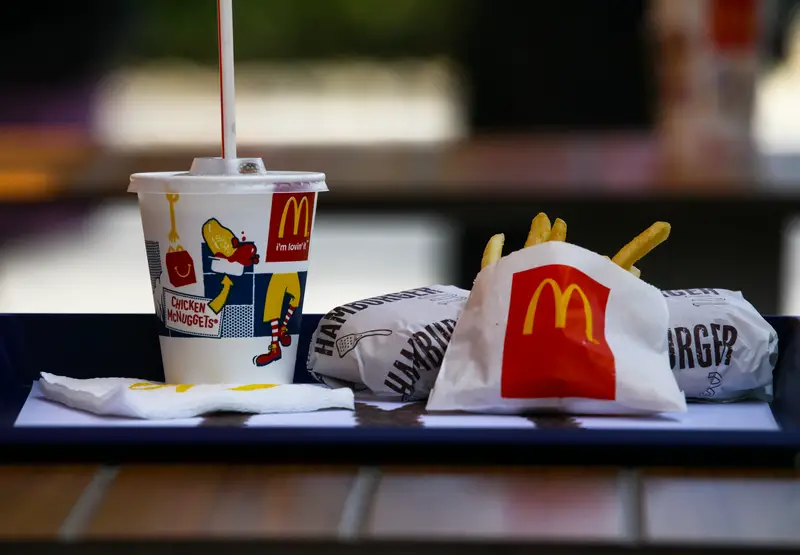
Remember when you could walk into a McDonald’s with five bucks and walk out with a full meal and change? That era is gone. Not winding down, not evolving — gone. The Dollar Menu, once a cornerstone of fast food in America, has been quietly dismantled over the past few years and replaced with something that costs two to three times as much. McDonald’s is betting you won’t notice, or at least that you won’t care enough to stop showing up. And honestly? They might be right.
A Plain Hamburger Went From 15 Cents to $1.99
Let’s start with the number that stings the most. A plain McDonald’s hamburger — the most basic thing on the menu, the kind your parents grabbed you on the way home from soccer practice — costs $1.99 in 2026. When McDonald’s opened its first restaurants back in 1955, that same burger was 15 cents. Yes, inflation is a thing. Nobody expects 1955 prices. But the pace of increases in just the last five years has been brutal. Average menu prices across the board have jumped roughly 40% since 2019, according to the company’s own numbers. That’s not gradual. That’s a sprint.
A bacon, egg, and cheese biscuit runs $4.79. A McCrispy sandwich is $4.99. Three McCrispy Strips will also cost you $4.99. These aren’t premium items. These are the regular menu. The kind of stuff that used to be in the “affordable” column. And if you want fries and a drink with any of it, you’re looking at a tab that would’ve been unthinkable a decade ago.
The $5 Meal Deal Was a Band-Aid
McDonald’s introduced a $5 meal deal in 2024, and they promoted it like it was a revolution. It wasn’t. It was damage control. Videos had gone viral on social media showing customers paying $17 for two Filet-O-Fish sandwiches or $3 for a single hash brown. People were angry. Surveys showed that customers no longer considered McDonald’s affordable. Think about that for a second — the restaurant literally synonymous with cheap food had lost that reputation.
The $5 deal offered a sandwich, fries, nuggets, and a drink. It was a legit bargain compared to ordering those items separately. But it was also a tacit admission that regular menu prices had gotten out of control. McDonald’s didn’t lower prices. They created a side menu that felt less painful. There’s a difference.
McValue 2.0 Is Coming — and $3 Is the New $1
In April 2026, McDonald’s is rolling out what it’s calling McValue 2.0. The centerpiece is a menu of items priced at $3 or less — things like a sausage biscuit, a 4-piece Chicken McNuggets, and a McChicken. There are also $4 breakfast meal deals that bundle a McMuffin, a hash brown, and a coffee.
This replaces the buy-one-add-one-for-a-dollar deal from 2025, which itself replaced the $5 meal deal as the main value push. McDonald’s keeps cycling through these programs like a DJ switching tracks at a party nobody’s dancing at. The company said in a message to franchisees that the new plan had “unanimous alignment” from franchisee groups. Training is already underway.
But here’s what you should notice: they’re calling $3 the value price point. During the Great Recession, that number was $1. One industry analyst put it perfectly — $3 is the new $1. That’s not a catchy marketing line. That’s the reality of eating in America right now.
Why the Original Dollar Menus Actually Died
The explanation is less dramatic than you might think. Dollar menus were never sustainable. They were loss leaders — items sold at or below cost to get you through the door, hoping you’d also buy a full-price combo or an extra dessert. For a while, it worked. McDonald’s used its Dollar Menu during the Great Recession to pull ahead of every competitor. Burger King famously tried to match by pricing its Double Cheeseburger at $1, even though it was unprofitable for franchisees at that price.
But the math stopped working. The cost of beef, chicken, bread, labor, rent, and basically every other input went up. Inflation means that $1 in 2002 is worth about $1.82 today. Restaurants were losing money on every dollar menu item sold, and franchisees — who own and operate about 95% of McDonald’s US locations — weren’t going to eat those losses forever. So the menus got tweaked, renamed, and gradually phased out. The Dollar Menu became the Dollar Menu & More, then the $1 $2 $3 menu, and now the “McValue” platform. Each iteration drifted further from that original promise.
Franchisees Are Pushing Back
This part doesn’t get enough attention. McDonald’s corporate doesn’t actually set menu prices at most locations. They recommend prices, run marketing campaigns, and control supply chains. But the person who decides what you pay for a Big Mac in Topeka is the franchisee who owns that restaurant. And a lot of those franchisees are not happy.
The National Owners Association, an independent group of McDonald’s franchisees, recently compiled a list of 15 items they’re calling a “Franchisees Bill of Rights.” That’s a pretty aggressive name for a business document. The tensions have been building: McDonald’s corporate has been tightening standards for renewing franchise agreements, increasing royalty fees for new operations, and requiring store renovations. Franchisees feel squeezed between corporate’s demand for lower prices and the rising costs of actually running a restaurant. When McDonald’s announces a $3 menu, it’s the franchisee who absorbs a thinner margin, not the corporation.
The K-Shaped Economy Is Showing Up at the Drive-Through
There’s a bigger story here, and it’s not really about hamburgers. McDonald’s CEO Chris Kempczinski has been unusually blunt in recent earnings calls about what the company is seeing. High-income customer traffic has remained stable. Lower-income customers have been pulling back. He’s said McDonald’s will “absolutely make sure to protect their leadership position in value” and that lower-income consumers are “particularly sensitive to value and affordability.”
Fortune described the new $3 menu as a symptom of America’s K-shaped economy — where wealthy people keep doing fine while working-class families fall further behind. When a post about the $3 menu went up on the prediction market platform Kalshi, it racked up over 4 million views on X. One reply that said “Oh it’s a RECESSION recession” got 2.6 million views on its own. People aren’t just noticing — they’re reading between the lines.
Every Chain Is Playing the Same Game
McDonald’s isn’t alone in this. Wendy’s rolled out Biggie Bag deals priced between $5 and $7, with six meal choices and even nine different nugget flavors. Burger King has been running its own $5 Your Way Meal periodically. Taco Bell introduced a Luxe Value Menu in January 2026 with 10 items priced from $1.19 to $2.99. The entire fast food industry is scrambling to look like the cheapest option while quietly making everything more expensive.
Restaurant traffic is still a broad problem across the industry. Gas prices aren’t helping. Economic uncertainty isn’t helping. And customers who got used to $5 meals during the pandemic recovery aren’t thrilled about $10 being the new minimum for a burger, fries, and a Coke. The value wars are less about generosity and more about survival — chains fighting for a shrinking pool of customers who are watching every dollar.
The Numbers Say the Strategy Is Working (For Now)
Here’s the thing — McDonald’s value push does appear to be gaining traction. After same-store sales slowed and dipped through 2024 and the first half of 2025, the numbers bounced back in the second half of the year. US sales rose 6.8% in the fourth quarter of 2025, the biggest jump in about two years. Analysts had only expected a 4.9% gain. The $5 meal deal, holiday promotions, and bringing back the Monopoly sweepstakes all played a role.
McDonald’s also climbed back to No. 10 on Entrepreneur’s Franchise 500 list for 2026, its first top-10 finish since 2020 when it ranked No. 3. That’s a sign the brand is regaining some of its old momentum, even if the menu looks nothing like it used to.
What You Actually Need to Spend in 2026
Let’s be honest about what a trip to McDonald’s costs today. If you want a burger, fries, and a drink — the classic fast food trio — you’re probably spending at least $8 to $10 on your own. A viral graphic making the rounds compared that to what the same order once cost: medium fries at 99 cents, a cheeseburger at 79 cents, a Big Mac at $1.85, a Filet-O-Fish at $1.29, and a medium drink at 89 cents. A whole spread for about $12. Today that same order would be more than double.
The best current deal if you’re feeding two people is the 6-piece Chicken McNuggets meal — two 6-piece McNuggets, two fries, and two drinks for $9.19, which works out to about $4.59 per person. The snack wraps, which came back in July 2025 after a nine-year absence, run $2.99 each in spicy or ranch. Those are your budget plays. Everything else is going to cost you.
The Dollar Menu didn’t just disappear overnight. It was slowly hollowed out, rebranded, and replaced with something that costs three times as much but comes with a friendlier name. McDonald’s is still trying to be the place where working Americans eat. But the gap between what the brand promises and what the register shows keeps getting wider. And right now, $3 is as close to a dollar as anyone’s going to get.

