

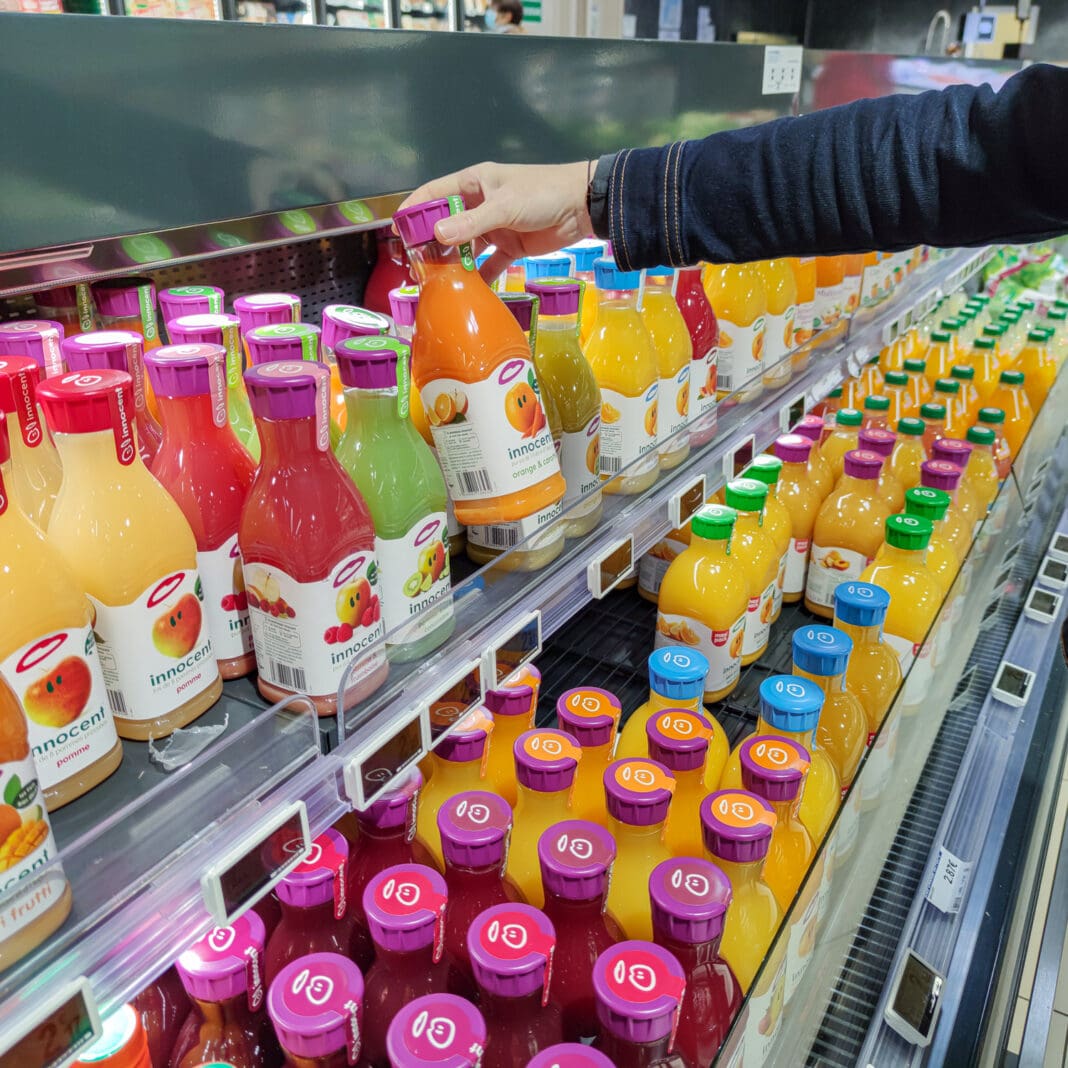
You’re standing in the juice aisle, half awake, grabbing whatever orange juice has the prettiest label. Bright colors, pictures of sunshine and sliced oranges, maybe a little “100% natural” claim thrown in for good measure. You toss it in the cart and move on with your life. Here’s the thing though — a lot of what’s being sold as orange juice barely qualifies. Some of it isn’t even juice at all. And even the stuff that technically is juice can be shockingly bad. I went through the research, the reviews, and the ingredient labels so you don’t have to. Here are the brands to leave on the shelf.
SunnyD
Let’s get the obvious one out of the way. SunnyD is not orange juice. It’s not even pretending to be orange juice, though the packaging sure tries its hardest. The brand itself calls it an “orange-flavored citrus punch,” which is corporate speak for “this is mostly water and high-fructose corn syrup.” The actual juice content? Five percent. And that five percent isn’t even all orange — it’s a cocktail of orange, tangerine, apple, lime, grapefruit, and pear concentrates. On top of that, yellow 5 and yellow 6 food colorings give it that unnaturally bright hue.
SunnyD exploded in popularity after debuting in 1963, and for decades parents bought it thinking it was a healthier alternative to soda. Then came the infamous incident where a girl in the UK reportedly turned yellow from drinking too much of it. Sales cratered, the brand rebranded from “Sunny Delight” to “SunnyD,” and they’ve been tinkering with the formula ever since. According to multiple reviewers, the current version doesn’t even taste as good as the original. An 8-ounce serving still packs 10 grams of added sugar. If you want orange juice, this isn’t it. Not even close.
Tampico Citrus Punch
Tampico might be even worse than SunnyD, which is saying something. The first two ingredients on the label are water and high fructose corn syrup. It technically contains orange juice, tangerine juice, and lemon juice, but none of that matters because the flavor is completely artificial. One reviewer described it as an “utterly terrible counterfeit” that will ruin your mood. The instant it hits your mouth, something feels wrong. But the real kicker is the aftertaste — people describe it as horrendous, the kind of lingering chemical flavor that makes you question your life choices at 7 a.m.
Tampico is dirt cheap, which is why it ends up in so many shopping carts. But there’s a reason it’s dirt cheap. You’re paying for flavored corn syrup water with an orange tint. Save your two dollars.
United Dairy Orange-Flavored Drink
Here’s one that flies under the radar. United Dairy’s orange-flavored drink has almost no nutritional value. You’d reasonably expect any product with “orange” on the label to at least contain some vitamin C. Nope. No vitamin C. No vitamin D either. What it does contain is 20 grams of added sugar per 12-ounce serving. That’s 40 percent of your recommended daily value in a single glass. You’re basically halfway to your daily sugar limit before breakfast is even over. This is the kind of product that exists in a gray area between juice and sugar water, and it lands much closer to the sugar water side.
Juicy Juice Orange Tangerine
Juicy Juice markets itself as 100 percent juice with no high fructose corn syrup or artificial colors, and that’s technically true. The problem is that it barely qualifies as orange juice. Look at the ingredient label and you’ll see why — the first three ingredients are apple, pear, and grape juice concentrates. Orange juice doesn’t show up until the fourth ingredient. So you’re essentially drinking apple-pear-grape juice with a little orange mixed in. The sugar content hits 27 grams per serving with zero protein, when real orange juice typically has around 2 grams of protein. It does deliver 100 percent of your daily vitamin C, but that alone doesn’t make it worth buying if you’re looking for actual orange juice.
Ocean Spray Orange Juice
Ocean Spray is known for cranberry juice, and maybe they should’ve stayed in their lane. Their orange juice is made from concentrate, contains 31 grams of sugar per serving, and is shelf-stable — meaning it sits on a regular store shelf instead of in the refrigerated section. That’s a red flag. Fresh orange juice needs refrigeration. If it’s sitting at room temperature for months, something has been done to it that you probably don’t want to think too hard about.
The ingredient list is short — filtered water, orange juice from concentrate, and ascorbic acid — but that 31 grams of sugar is hard to explain given that there’s no added sweetener listed. The reviews are brutal. One person gave it one star and wrote that it’s “the weirdest tasting juice” and “doesn’t taste anything like orange juice.” When your orange juice doesn’t taste like oranges, you’ve got a problem.
Great Value Orange Juice
Walmart’s store brand comes in three varieties: original, country style with pulp, and one fortified with calcium and vitamin D. The original is pasteurized and made from concentrate using oranges from Belize, Brazil, Costa Rica, Mexico, and the United States. No added sugars. Sounds fine on paper. In practice, it’s pretty rough.
Reviewers consistently describe it as watery and muted. One said it’s “like you took mediocre orange juice and then added water to it.” Another called it “a dull yellow color, somewhat like a sad banana” with a “suspiciously creamy texture” and a “bitter almost medicinal taste.” One customer even said it tastes “like it is stored in a rubber hose.” The brand also includes a notice that its orange juice may contain soy, wheat, milk, or shellfish — which is a sentence that should never appear on a juice container. It’s the kind of juice you’d tolerate at a hotel continental breakfast and nowhere else.
Kroger Orange Juice
Kroger’s store brand orange juice is made from concentrate, and the process does not treat it kindly. Multiple reviewers have flagged issues with both taste and texture. The color is off — described as a dull yellow rather than the vibrant orange you’d expect. The texture has been called “suspiciously creamy,” which is not a compliment when you’re talking about orange juice. And the flavor? “Bitter” and “almost medicinal” come up repeatedly. One particularly vivid review said it “tastes like it is stored in a rubber hose.” For a product that’s supposed to be a refreshing way to start your morning, that’s a death sentence.
Dole Orange Juice
Dole’s no-pulp orange juice is made from concentrate and contains 75 percent juice plus “other natural flavors.” No added sugar, and it’s pasteurized with added vitamin C. Sounds acceptable. But the drinking experience tells a different story. The color is a decent yellow-orange, but the scent is off — slightly bitter and nothing like what fresh oranges should smell like. The first sip is pleasant enough, a mix of sweet and sour, but then comes a bitter aftertaste that doesn’t go away. When a juice’s most memorable quality is how bad the finish tastes, it doesn’t deserve your three or four dollars.
Simply Light Orange Juice
Simply Orange’s regular version is widely considered one of the better store-bought options — it’s just pasteurized orange juice with no added sugars. But the “Light” version is a completely different animal. To cut calories and sugar by 50 percent, they added stevia leaf extract, and the result is not great. The texture becomes thin and watery, losing that thick, almost foamy quality that makes orange juice feel satisfying. Worse, the stevia is overwhelming — it creates an artificial sweetness that completely drowns out any real orange flavor. One taster said they could only manage two sips before putting it down. If you like Simply Orange, stick with the original. The light version is a different drink entirely, and not in a good way.
Trader Joe’s Fresh Squeezed Orange Juice
This one might surprise you. Trader Joe’s has a loyal fanbase that will defend almost anything the store sells, but the fresh-squeezed orange juice is a miss. It’s sour, bitter, and has a strange smell that’s not exactly chemical but definitely not right. The color looks great — rich and deep — but taste matters more than appearance. It’s also unpasteurized, which means small children, pregnant women, and anyone with a compromised immune system should avoid it entirely. For a product that costs more than most competitors, it doesn’t deliver.
What You Should Buy Instead
If you’re willing to spend a bit more, brands like Natalie’s, Uncle Matt’s, and Lakewood Organic consistently rank at the top. Lakewood fills each bottle with 10 to 14 freshly pressed certified-organic oranges with no preservatives, GMOs, or added sugars. Evolution Fresh Organic Pure Orange uses cold-press extraction, which preserves more nutrients than traditional methods — though at around $10 a bottle, it’s a splurge. For a solid everyday option, Simply Orange (the regular version, not the light) contains only pasteurized orange juice and nothing else. Florida’s Natural and Tropicana also perform well in both taste tests and ingredient quality. The easiest rule of thumb: if the ingredient list is longer than two or three items, or if the word “concentrate” appears, keep looking.

