

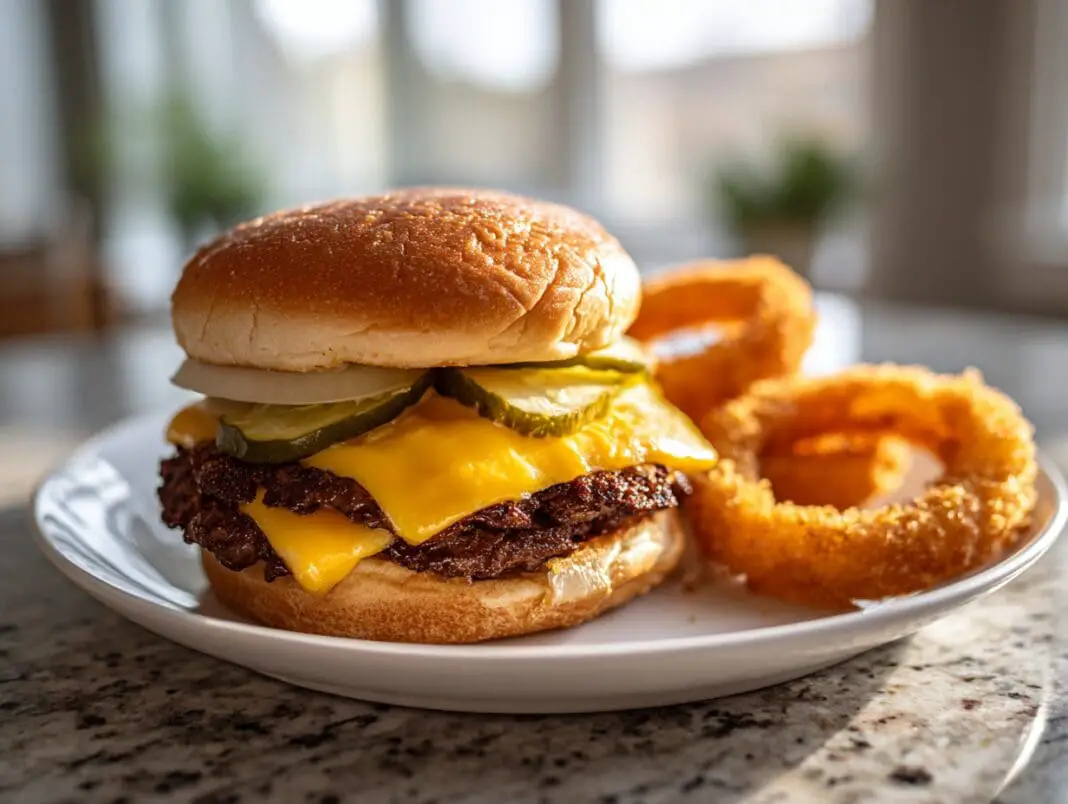
A burger from the 1950s would look almost nothing like the towering, loaded burgers that show up on most restaurant menus today. They were thinner, smaller, and way simpler. The patties were smashed flat on a hot griddle, cooked in butter, and topped with little more than onions, pickles, and mustard. And honestly? They were probably better than most of what we eat now. Here’s how to bring that classic style back into a modern kitchen.
The patties were smashed thin, not thick
If the only burgers in regular rotation at home are big, fat, half-pound patties, then the 1950s version might come as a surprise. Back then, nobody was stacking thick slabs of beef. The standard move was to take a ball of ground beef and press it flat on a screaming-hot griddle. The result was a thin patty with crispy, almost lacy edges. This is what people now call a “smashburger,” and it’s actually a technique that goes back over 70 years. The whole point was speed and crispiness.
Burger chains were booming in the ’50s, and they needed to push out food fast. A thinner patty cooked much quicker than a thick one, and it also kept more moisture locked in. A rounded ball of beef went onto the griddle, then got pressed flat with a spatula right before toppings were added. The edges got that perfect crust that made every bite count. It’s a simple method that anyone can copy at home with a cast iron skillet and a sturdy spatula.
Butter or lard went in the pan first
Cooking spray and olive oil are common go-to options for frying today. But in the 1950s, home cooks reached for butter, lard, or even saved bacon grease before anything touched the pan. That was the standard. Before the beef patty hit the skillet, a good chunk of butter or a spoonful of lard melted down to coat the surface. The fat added richness to an already beefy patty and helped create that golden-brown crust everybody loved. It sounds indulgent, but that was just Tuesday night dinner back then.
Keeping a tin of bacon grease on the stove was completely normal in the ’50s. People fried vegetables in it, cooked eggs in it, and absolutely used it for burgers. Meat was the main event at almost every meal, and nobody worried about using animal fat to cook more animal fat. For this recipe, butter is the way to go. It gives the patty a rich, slightly nutty taste and helps the outside get crispy without drying out the inside. Just a tablespoon or two in a hot skillet does the trick.
Onions went right on top while cooking
Here’s something that might change the way burgers get made at home. In the 1950s, cooks didn’t wait until the burger was done to pile on toppings. They placed sliced onions directly on top of the patty while it was still cooking on the griddle. The heat from the meat started softening and caramelizing the onions right there. When the patty got flipped, the onions pressed into the surface and almost became part of the burger itself. It was a two-for-one cooking method that saved time and added a ton of taste.
This technique was used everywhere, from fast food spots to home kitchens. White Castle is often credited with helping popularize the idea. The chain’s original slider recipe called for poking holes in the patty and cooking it on a bed of diced onions. The onion steam cooked the meat from below while adding a sweet, savory taste. Even if someone ordered a plain burger at a diner, the onions already on the grill would season the meat anyway. Raw onion on a burger is more of a modern thing — cooked onions were the ’50s standard.
The recipes were surprisingly simple
Modern burger recipes often call for eggs, breadcrumbs, Worcestershire sauce, garlic powder, and a long list of other mix-ins. That’s fine, but it would have looked strange in a 1950s kitchen. Back then, a typical homemade burger recipe called for ground chuck, butter, onions, and maybe a pinch of salt and pepper. That’s it. No binders, no fillers, and definitely no fancy seasoning blends. The beef was the star, and people trusted it to do the heavy lifting all on its own.
Cookbooks from the era kept things stripped down and straightforward. There was no need to overthink a burger. Good ground beef, a hot pan with butter, and some onions were all it took. This is actually great news for anyone who wants a quick weeknight dinner. Fewer ingredients means less prep, less mess, and a faster path from fridge to plate. Sometimes the simplest version of something is also the best version, and ’50s burgers are a strong case for that argument.
The meat was fresh, not frozen
Most grocery store burger patties today come frozen in a box. But in the early 1950s, the beef going into burgers was usually fresh and never frozen. The mass production of corn-fed cattle and giant feedlots hadn’t fully taken over yet. Much of the beef was still grass-fed and came from local sources. Restaurants ground their meat on-site in many cases, and home cooks bought fresh ground beef from the butcher counter. The whole supply chain was shorter and simpler back then.
White Castle actually started grinding meat in front of customers to prove how fresh and pure its patties were. McDonald’s also began with fresh beef before switching to frozen as the company grew. For this recipe at home, picking up fresh ground chuck from the meat counter makes a real difference. It holds together better, tastes beefier, and cooks more evenly than a frozen patty pulled from a bag. It’s a small step that gets the result much closer to what a 1950s diner would have served.
Mustard, ketchup, and pickles were standard
Bacon jam, truffle aioli, sriracha mayo — modern burger toppings have gotten wild. But in the 1950s, condiments stayed classic. A standard burger came with yellow mustard, ketchup, and dill pickles. Maybe some cheese if someone was feeling fancy. That was the formula, and it worked. There was no need for twelve different sauces or a special spread. The simplicity let the beef and those caramelized onions shine through without getting buried under layers of competing tastes.
That said, the ’50s weren’t completely boring on the toppings front. Good Housekeeping magazine started suggesting creative additions like fried eggs, flavored butters, chives, and even apple slices during this era. But for the everyday burger, the classic trio of mustard, ketchup, and pickles ruled the day. Sticking with these basics for a 1950s-style smashburger keeps things authentic. A slice of American cheese melted on top right before serving is the perfect finishing touch — exactly how it would have been done at any diner counter in 1955.
The burgers were much smaller than today
Ever order a burger at a restaurant and wonder how anyone is supposed to fit it in their mouth? Those massive, multi-layered towers of meat and cheese are a modern invention. A typical 1950s hamburger was about a third the size of what most places serve now. The CDC has actually noted that burger portions have grown dramatically over the decades. A ’50s burger was modest — a single thin patty on a soft bun, maybe three or four inches across. It was a meal, not a challenge.
This smaller size actually made sense for a lot of reasons. The thin, smashed patties cooked fast and were easy to eat in just a few bites. People could order two if they were really hungry. The buns were soft and simple, usually just plain white rolls. For this recipe, making the patties around two to three ounces each keeps them in that authentic 1950s range. They cook in about two minutes per side and are the perfect size for a quick, satisfying meal without feeling overstuffed afterward.
Drive-ins made burgers a cultural event
Before the drive-thru window became the norm, there was the drive-in. People pulled their cars into a lot, rolled down the window, and a carhop brought food right to the car. It was a social event as much as a meal. Teenagers hung out, families gathered, and burgers were the main attraction. The 1950s were the peak of the drive-in era, and it turned the simple hamburger into something almost iconic. Eating a burger was about the experience, not just the food.
McDonald’s and In-N-Out had both opened by the late 1940s. Burger King followed in 1954. These chains were small and regional at first, but they grew fast through the ’50s as car culture exploded across the country. The drive-in format was perfect for the era — cars were everywhere, families wanted convenience, and a cheap burger hit the spot. Making these burgers at home can bring back a little bit of that feeling. Set up some trays, put on some oldies, and eat in the backyard. It’s not a parking lot, but it’s close enough.
Gadgets like the Bun-Burger Patty Maker helped
The 1950s were absolutely obsessed with kitchen gadgets. People crammed their kitchens full of specialized electric appliances and hand-crank tools that each served one very specific purpose. One of the more clever inventions for burger lovers was the Bun-Burger Patty Maker. It was shaped like a hamburger bun and closed like a sandwich around a ball of ground beef. The result was a perfectly round patty, ready for the skillet. No more patties falling apart or coming out in weird shapes.
According to reports from the era, a well-stocked 1950s kitchen could have close to three dozen electric appliances. Having the latest gadget was a status symbol. For burgers specifically, the patty maker solved a real problem — hand-shaping thin patties can be tricky, especially when trying to keep them uniform. Today, a simple technique works just as well: press the meat ball flat with the bottom of a plate or a sturdy spatula directly on the hot griddle. No vintage gadget required, but it’s fun to know they existed.
Making a 1950s-style smashburger at home is one of those things that feels almost too easy to be this good. Fewer ingredients, a simpler method, and a smaller portion somehow add up to a better burger than most complicated modern recipes. The key is high heat, good beef, butter, onions, and the confidence to keep things basic. Give this recipe a try and see why millions of Americans in poodle skirts and letterman jackets couldn’t get enough of these crispy little burgers.
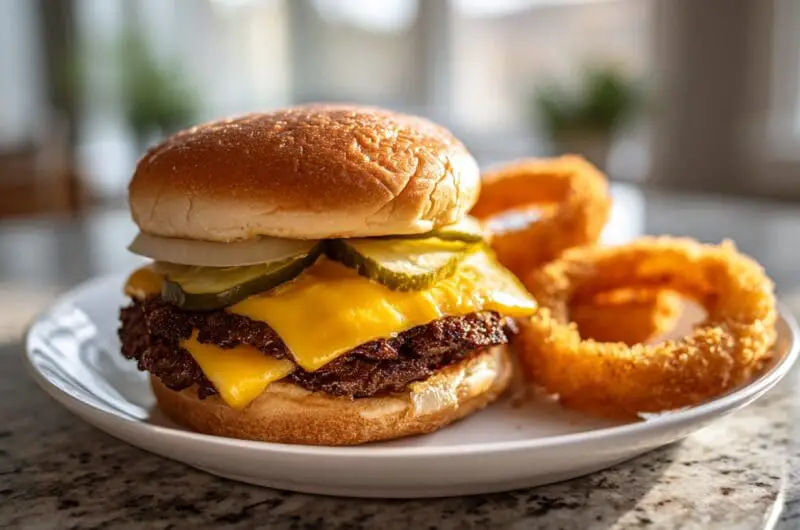
Classic 1950s-Style Smashburger
Course: Main CourseCuisine: American4
servings10
minutes10
minutes380
kcalThin, crispy-edged smashburgers cooked in butter with caramelized onions, just like they made them at every diner in the 1950s.
Ingredients
1 pound fresh ground chuck (80/20 lean-to-fat ratio)
2 tablespoons unsalted butter
1 medium yellow onion, thinly sliced into rings
4 slices American cheese
4 soft white hamburger buns
Kosher salt, to taste
Black pepper, to taste
Yellow mustard, for serving
Dill pickle slices, for serving
Directions
- Divide the pound of ground chuck into 4 equal portions, about 4 ounces each. Roll each portion into a loose ball — don’t pack the meat too tightly or the burgers will turn out dense. Set them on a plate and let them come to room temperature for about 5 minutes.
- Heat a cast iron skillet or flat griddle over high heat for at least 3 minutes until it is very hot. Add 1 tablespoon of butter and let it melt completely, swirling to coat the surface. The butter should sizzle immediately — if it doesn’t, the pan isn’t hot enough yet.
- Place 2 beef balls onto the hot skillet, spacing them a few inches apart. Using a sturdy metal spatula or the bottom of a small plate, press each ball down firmly until it is about ¼ inch thick. You should hear a loud sizzle — that’s the crust forming. Season the tops generously with salt and pepper.
- Immediately place a small pile of sliced onion rings on top of each smashed patty. Press the onions down gently so they stick to the surface of the raw side. Let the patties cook without moving them for about 2 minutes, until the edges are deeply browned and crispy.
- Using the spatula, carefully flip each patty so the onions are now on the bottom, pressing against the hot skillet. The onions will start to caramelize directly on the griddle surface. Place a slice of American cheese on top of each patty right after flipping.
- Cook for another 1 to 2 minutes until the cheese is melted and the onions underneath are soft and golden. Remove the patties from the skillet and set them on a plate. Add the remaining tablespoon of butter and repeat the process with the other 2 beef balls.
- While the second batch cooks, lightly toast the hamburger buns in a dry skillet or under the broiler for about 30 seconds. Watch them closely so they don’t burn. Toasting the buns gives them a slight crunch and keeps them from getting soggy once the burger goes on.
- Spread yellow mustard on the bottom bun, add the cheesy smashed patty with its onions, and top with a few dill pickle slices. Place the top bun on and press down gently. Serve immediately while everything is hot and the cheese is still melty.
Notes
- Ground chuck with an 80/20 fat ratio works best for smashburgers because the fat keeps the thin patty moist and helps create crispy edges.
- Do not press the patty more than once. Smash it flat when it first hits the skillet, then leave it alone so the crust can form properly.
- For an even more authentic 1950s experience, skip the ketchup and use only yellow mustard, onions, and pickles as toppings.
- If making multiple batches, keep finished burgers warm on a plate loosely tented with foil while the remaining patties cook.
Frequently Asked Questions
Q: What kind of ground beef works best for a 1950s-style smashburger?
A: Ground chuck with an 80/20 lean-to-fat ratio is ideal. The higher fat content helps the thin patty stay juicy during the quick, high-heat cooking process. Leaner ground beef, like 90/10, will dry out too fast and won’t develop those crispy edges that make a smashburger so good.
Q: Can this be made on an outdoor grill instead of a skillet?
A: A flat-top griddle attachment for an outdoor grill works great, but a regular grill with grates is not the best choice. The thin patty can fall apart or slip through the grates. A cast iron skillet or flat griddle gives the most direct contact with the cooking surface, which is essential for getting that crust.
Q: Why do people put onions on the patty before flipping?
A: Placing onion slices on the raw side of the patty means they get pressed into the meat when it’s flipped. As the onions hit the hot griddle, they caramelize and almost fuse with the burger. This technique was standard at diners and fast food spots in the 1950s and adds a sweet, savory taste without needing any extra steps.
Q: How do I keep the smashburger from sticking to the spatula when I press it?
A: Use a sturdy stainless steel spatula with a flat, wide edge. If sticking is a problem, lightly coat the spatula with a bit of cooking spray or rub it with a small amount of butter before pressing. Press down firmly in one quick motion and then lift straight up without twisting.

