

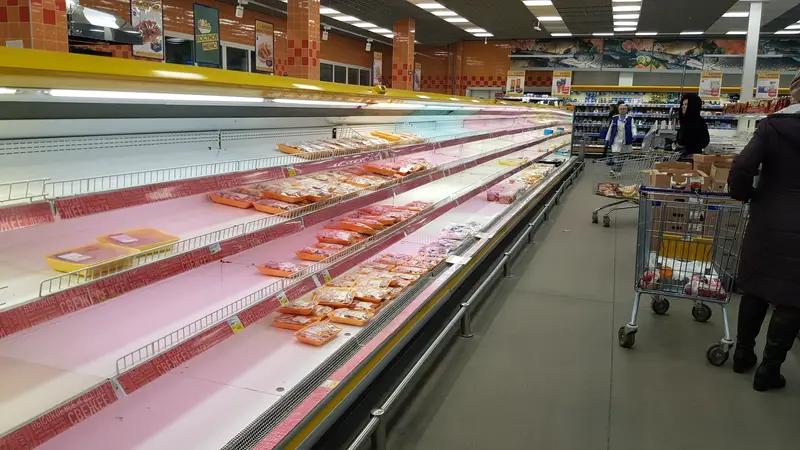
Walk into your local Kroger or Walmart right now and you’ll probably still find beef on the shelves. But look closer. The selection is thinner. The prices are eye-watering. And the situation that created this mess isn’t going away anytime soon. The U.S. cattle herd just dropped to roughly 86.2 million head — a number we haven’t seen since Harry Truman was president. That’s not a typo. We’re talking about a 75-year low in the number of cattle in this country, and the forces driving that decline are stacking on top of each other in ways that make a quick fix impossible.
Beef prices have climbed over 50% since 2020. The beef and veal category specifically is up 14.7% year over year, while overall food inflation sits at just 3.1%. Those aren’t abstract numbers — that’s the difference between a $9 burger and a $12 burger, between ground chuck at $5 a pound and ground chuck pushing $7 or $8. And the USDA expects prices to rise another 6.9% in 2026. So what happened?
A Drought That Wrecked Western Ranching
The single biggest reason we’re here is drought. Years of it. Across the American West, cattle ranching depends on grasslands — wide open rangeland where cows eat for free, basically. When the rain doesn’t come and the snowpack doesn’t build up in winter, that grass doesn’t grow. And when the grass doesn’t grow, ranchers have a serious problem.
Many ranchers tried to hang on. Some hauled water by the truckload just to keep their animals alive for a few more weeks. Others paid record prices to ship hay from hundreds or even thousands of miles away, sometimes spending more on freight than on the feed itself. But at a certain point, the math stops working. You can’t keep feeding animals you can’t afford to feed.
So ranchers started selling off their herds. Including their breeding cows — the ones that produce next year’s calves. That created a temporary glut of beef on the market a few years back, which actually kept prices stable for a while. But it was a short-term fix that created a long-term disaster. Every breeding cow sent to slaughter is a cow that won’t produce calves. And that’s how you end up with the smallest cattle herd since 1951.
The Cost of Raising Cattle Has Exploded
Drought is the headline, but the financial squeeze on ranchers goes way beyond water and grass. Since 2020, input costs for ranchers have risen more than 50%, according to the American Farm Bureau Federation. Fuel, fertilizer, interest on loans, labor — all of it has skyrocketed. When drought forces ranchers off grass and onto commercial grain feed, that’s yet another cost that didn’t used to exist.
Here’s the cruel irony: cattle prices are at record highs, which sounds like it should be great for ranchers. In August 2025, the five-market weighted average price for fed steers hit $243 per hundredweight — a record. But those high prices actually create a perverse incentive. When a young female cow (called a heifer) is worth a fortune at market, selling her for meat is often more profitable than keeping her around to breed. Brady Blackett, a third-generation Angus cattle producer in Utah, described it as a “perfect storm” — healthy competition for cattle, not enough of them, and prices at historic highs.
So even though conditions might be improving in some areas, many ranchers are choosing to cash in rather than rebuild. And the ones who do want to rebuild are scared. They watched drought and economic chaos destroy their operations once already. The fear that it could happen again is keeping many from expanding their herds.
A Parasitic Fly Shut Down the Mexican Border
If the drought and cost problems weren’t enough, there’s a bug making everything worse — literally. The New World screwworm, a parasitic fly that lays its eggs in the open wounds of livestock, was detected in Mexico about a year ago. The flies’ larvae eat living tissue. It’s as horrifying as it sounds, and it’s deadly to cattle.
To prevent the screwworm from crossing into the United States, the USDA shut down livestock imports from Mexico. That matters more than you might think. In 2024, the U.S. imported approximately 1.24 million head of cattle from Mexico — the vast majority of them feeder cattle that go straight into American feedlots. For 2026, those imports are effectively zero. No timeline for reopening has been announced.
Ben Weinheimer, President and CEO of the Texas Cattle Feeders Association, warned that producing without those Mexican cattle in 2026 could mean one billion fewer pounds of beef just in Texas, Oklahoma, and New Mexico alone. The USDA has committed more than $850 million to fighting the screwworm, including a $100 million initiative for prevention tools and a new facility in Texas that can release 100 million sterile flies per week to disrupt the pest’s reproduction. But none of that reopens the border tomorrow.
Meatpacking Plants Are Closing
When there aren’t enough cattle, the massive processing plants that turn them into the steaks and ground beef on your grocery shelf can’t operate profitably. And they’re not. Tyson Foods — the country’s biggest meatpacker — reported a $319 million operating loss in its beef division in the first quarter of fiscal 2026. That’s more than 12 times the $26 million loss from the same period a year earlier.
In January, Tyson permanently closed its beef plant in Lexington, Nebraska — a facility that could process about 5,000 cattle per day. That closure cut 3,200 jobs. The company also reduced its Amarillo, Texas plant to a single shift. JBS, another major processor, posted a $293 million loss at its North American beef operation. Swift Beef Co., a JBS subsidiary, closed a facility in Riverside, California.
Industry experts say at least one more big plant and several regional ones could close in the next 18 months. The pressure is worst in the South, where plants typically source cattle from Mexico. In Texas, ranchers are still working through some cattle that were shipped before the border closed, but those numbers are dwindling fast.
The Big Four and the Price-Fixing Question
There’s another layer to this story that has nothing to do with weather or bugs. Four companies — JBS, Cargill, Tyson Foods, and Marfrig-owned National Beef — control roughly 85% of the U.S. beef processing market. In 1980, that figure was 36%. That concentration gives these companies enormous power over what ranchers get paid and what consumers pay at the store.
USDA data shows that meat packers received just 5% of each retail dollar for choice beef between January and August 2025, while producers got 54% and retailers took 41%. In November 2025, President Trump directed the Department of Justice to investigate the Big Four for potential collusion, price fixing, and price manipulation. Whether that investigation leads anywhere remains to be seen, but the fact that it’s happening at all tells you how much political pressure beef prices are generating.
Why This Won’t Fix Itself for Years
Here’s the part that should really concern anyone who likes a good burger: you can’t speed up biology. A cow has a nine-month gestation period. Once a calf is born, it takes another 18 to 22 months for that animal to reach processing weight. If a rancher decides today to keep a heifer for breeding instead of selling her, it’ll be roughly 30 months — that’s 2028 — before her calf adds any meaningful growth to the national herd. You cannot manufacture cows in a factory.
The U.S. is now in year 13 of the current cattle cycle and year eight of herd contraction. There are some signs of a turnaround — beef replacement heifers (young females selected for breeding) are up in the latest USDA report, and the cattle that do exist are heavier than ever, meaning more meat per animal. But full recovery in herd numbers isn’t expected until 2027 at the earliest, and the effects won’t reach grocery shelves until 2028 or 2029.
Americans Are Starting to Blink
For years, demand for beef stayed rock solid no matter how high prices climbed. Americans love their hamburgers and steaks, and record demand in 2025 was part of the reason retailers could keep raising prices without worrying about losing sales. But there are cracks forming.
Research firm Circana has been tracking a shift: for the first time, spending on ground beef — historically one of the fastest-growing categories — has hit a plateau. Shoppers are finally starting to push back, substituting cheaper proteins like pork and chicken. At Block 16, a sandwich shop in Omaha, the burger that cost $8.95 before the pandemic now runs $11.95, entirely because of costlier meat.
As one Nebraska rancher put it: if people are paying $6 for a Starbucks latte, $6 for a pound of beef that feeds a family of three doesn’t seem unreasonable. But whether that logic holds when ground chuck hits $7 or $8 a pound is another question entirely.
What’s Actually Coming to Your Grocery Store
To be clear: beef is not going to vanish from store shelves. This isn’t an empty-shelf situation. But the selection will be smaller, the prices will be higher, and more of what you find will be imported rather than domestic. Over the past four years, U.S. beef imports have increased by over 80%, though tariffs on Brazilian beef (76%) and the Mexican border closure are squeezing those sources too. Trump signed a proclamation in February 2026 to temporarily quadruple the tariff-rate quota for Argentine lean beef trimmings, allowing an extra 80,000 metric tons to enter the country.
The American beef industry is caught in a trap that took years to build and will take years to escape. Drought gutted the herds. Rising costs discouraged rebuilding. A parasitic fly sealed the border. Plant closures are removing processing capacity. And through all of it, Americans kept buying beef like nothing was wrong — until the price tag finally got too painful to ignore. Something had to give. In 2026, it’s giving.

