

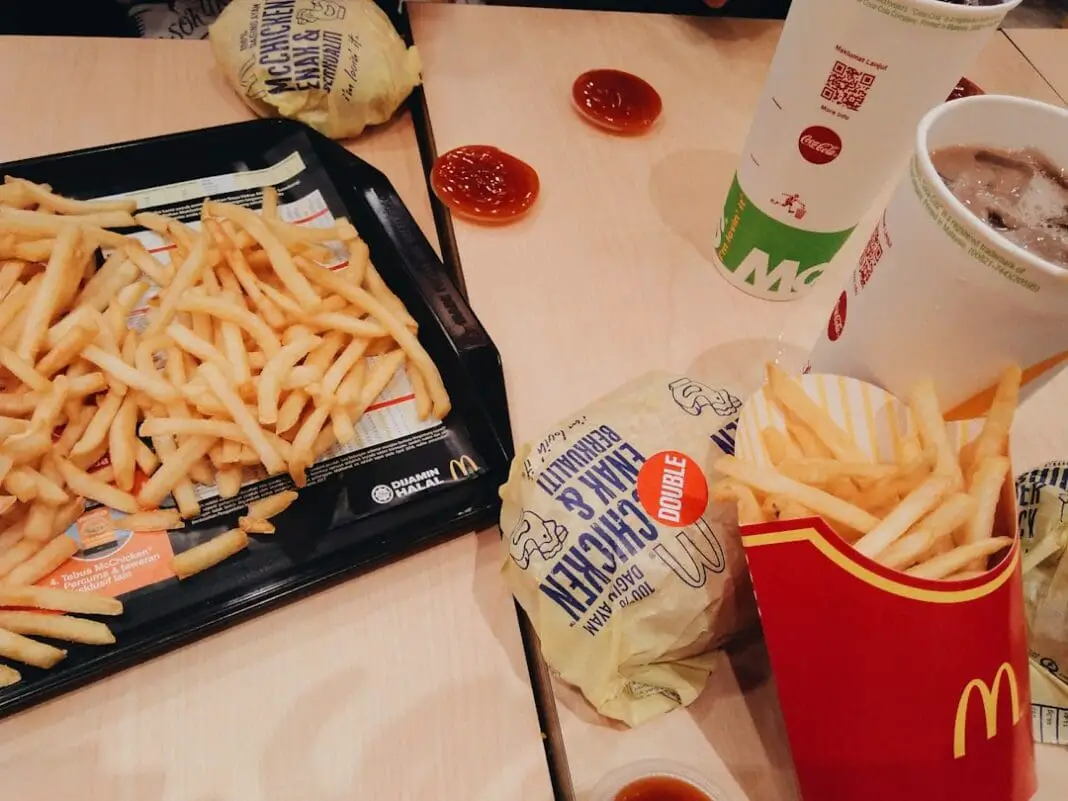
Ten cents. That’s what you paid for an order of McDonald’s french fries in 1955. A single dime. You could fish one out of your couch cushions and walk into the Golden Arches with enough for a bag of hot, salty, beef-tallow-fried potatoes. Today, depending on where you live, that same basic menu item will run you somewhere between $2.29 and $4.39. And the wild part? Even after you adjust for inflation, the math still doesn’t add up. The fries have gotten more expensive faster than almost everything else on the menu. Here’s the full story of how a ten-cent side dish became a four-dollar debate.
The Original McDonald’s Menu Was Absurdly Simple
When Ray Kroc opened his first franchised McDonald’s in Des Plaines, Illinois, in 1955, there were exactly nine items on the menu. That’s it. No Big Mac. No Chicken McNuggets. No McFlurry. Three food items and six drinks. The food was a hamburger for 15 cents, a cheeseburger for 19 cents, and an order of french fries for 10 cents. For drinks, you had Coca-Cola, root beer, orangeade, coffee, milk, and milkshakes in chocolate, strawberry, or vanilla. The milkshakes were the most expensive thing on the board at 20 cents. Everything else was a dime.
If you were feeling extravagant and bought one of every single item on the menu, your total came to $1.14. That left you 86 cents in change from a two-dollar bill. Try walking into a McDonald’s today with two bucks and see what happens. You won’t even get the fries.
What 10 Cents in 1955 Actually Means Today
Okay, so 10 cents sounds hilarious, but money was worth a lot more back then. Fair point. When you adjust for inflation, that dime from 1955 is worth roughly $1.17 to $1.21 in today’s dollars, depending on which inflation calculator you use. So in a perfectly logical world, a small order of McDonald’s fries today should cost about $1.20. It doesn’t. Not even close.
A small fry at McDonald’s today costs anywhere from $2.29 in cheap markets to $3.89 or more in expensive ones. A medium can hit $3.59. A large tops $4.39 in some locations. That means the price of fries has outpaced inflation by a wide margin — in some cases, nearly tripling what you’d expect them to cost if they’d just kept pace with the dollar.
Compare that to the hamburger. A basic McDonald’s burger in 1955 was 15 cents. Adjusted for inflation, that’s about $1.76 to $1.80. Today, in places like Stigler, Oklahoma — reportedly the cheapest McDonald’s in America — a hamburger costs $1.29. That’s actually less than the inflation-adjusted price. Even in average-priced markets, you can still find the basic burger at $1.49 or $1.99. The burger has more or less kept pace with inflation. The fries haven’t.
The Fries Were Cooked in Beef Fat and People Loved It
The original McDonald’s fries weren’t just cheap — they were different. Like, fundamentally different from what you eat today. When the fries first appeared on the menu in 1949, they were cooked in a shortening that was 93 percent beef tallow and 7 percent cottonseed oil. That beef fat is what gave them their famous flavor. People who tried them back in the day say they had a richer, meatier taste and a crunch that today’s version can’t quite match.
The recipe was straightforward: russet potatoes, sugar, Karo corn syrup, canola oil, hot water, salt, and then the whole thing got dropped into that beefy shortening. Ray Kroc was obsessive about quality control. He made sure the potatoes had the right solids content — between 20 and 23 percent — and he “cured” them by storing them at medium-high temperatures for weeks to convert sugars into starch. He even had a guy named Louis Martino develop a “potato computer” to calculate the exact frying time based on oil temperature fluctuations. For a 10-cent product, they were putting in serious effort.
Why McDonald’s Stopped Using Beef Tallow
In the late 1980s, a millionaire named Phil Sokolof — who’d suffered a heart attack at 43 — started taking out full-page newspaper ads in New York, Chicago, and other major cities calling out McDonald’s for using beef tallow. He basically accused the chain of being a threat to American health. The National Heart Savers Association piled on with a sustained campaign against saturated fats.
McDonald’s caved in 1990 and switched to vegetable oil. But they didn’t want to lose that signature taste entirely, so they added “natural beef flavor” — which is made from hydrolyzed wheat and milk. The irony is that the switch to vegetable oil initially meant more hydrogenated oils, which meant more trans fat. It took until 2008 for McDonald’s to finally ditch trans fats in U.S. and Canadian markets. So the “healthier” version of the fries spent nearly two decades containing something arguably worse than what it replaced.
In 2002, McDonald’s paid $10 million to settle lawsuits from people who’d been told the fries were vegetarian when they actually contained beef-derived flavoring. That’s a lot of money to spend on something that started as a 10-cent menu item.
The Portion Sizes Have Changed Too
Back in 1955, there was only one size of fries. It was about 2.4 ounces, or roughly 68 grams. That’s actually smaller than today’s small fries. So yes, today’s small is bigger than the only option available when the chain started.
Then in 1987, McDonald’s rolled out the Super Size option, which was about seven ounces — nearly three times the original serving. Super Size fries became iconic in their own right, the kind of thing you ordered when you were feeling reckless or just really hungry. The chain killed them in 2004, officially claiming it was about “menu simplicity.” Most people figured the real reason was the documentary “Super Size Me,” which came out that same year and basically made McDonald’s the poster child for American obesity. Either way, the massive portions disappeared. Today you get small, medium, or large, and even the large doesn’t match what Super Size used to be.
The Speedee Service System Made It All Possible
How did the McDonald brothers keep prices so low in the first place? They weren’t running a charity. The answer was their “Speedee Service System,” which was inspired by Ford Motor Company’s assembly lines. The idea was volume, speed, and low prices. Workers cranked out burgers and cheeseburgers on what was basically a food assembly line. Once made, burgers sat under warming lamps so they were ready the second a customer walked up. No waiters. No table service. No tipping. Just fast, cheap food.
That system is what caught Ray Kroc’s eye in 1954 when he visited the original San Bernardino location to sell the brothers milkshake blenders. He saw the efficiency and immediately knew it could be replicated everywhere. He signed a 10-year franchise deal and opened his Des Plaines location the next year. By 1961, he’d bought the brothers out entirely for $2.7 million. The Speedee Service System became the backbone of every McDonald’s on the planet.
Where Prices Stand Right Now
McDonald’s pricing varies wildly by location, which is part of what makes people so frustrated. At the oldest operating McDonald’s in Downey, California, fries cost $3.89. In Des Plaines — the city where Kroc opened his first franchise — fries are $3.29. In Stigler, Oklahoma, they’re $2.29. Same company, same fries, and over a dollar and a half difference depending on your zip code.
Between the first quarter of 2022 and the first quarter of 2024, the average amount spent per person per visit at a U.S. fast food restaurant jumped 25 percent, from $12 to $15. McDonald’s isn’t alone in raising prices, but the fries tell a specific story. According to one analysis, the average price of medium fries went up 138 percent from $1.59 to $3.79 between 2014 and recent years. McDonald’s disputed those exact figures but didn’t really offer an alternative number.
The Fries Outran Everything Else
Here’s what sticks with me. The hamburger, the original star of the menu, has roughly tracked inflation over 70 years. You can still get a basic McDonald’s burger for less than two bucks in a lot of places. The drinks are actually a better deal now than they were in 1955 — today’s small is 16 ounces compared to the original 7 ounces, and it costs $1.49 in many markets.
But the fries? They’ve blown past inflation by a mile. What used to be the cheapest food item on the menu — tied with drinks at a dime — now costs more than the hamburger in most locations. A small fry at $2.29 is $1.09 more than the inflation-adjusted price from 1955. At $3.89, it’s more than triple. Something that was once an afterthought, a 10-cent add-on, has become one of the most profitable items McDonald’s sells.
A dime bought you fries in 1955. Today it won’t buy you a single one of them out of the bag. The potatoes are different, the oil is different, the portion is slightly bigger, and the price is a lot bigger. The Golden Arches are still standing, but that 10-cent price tag is long gone.

